




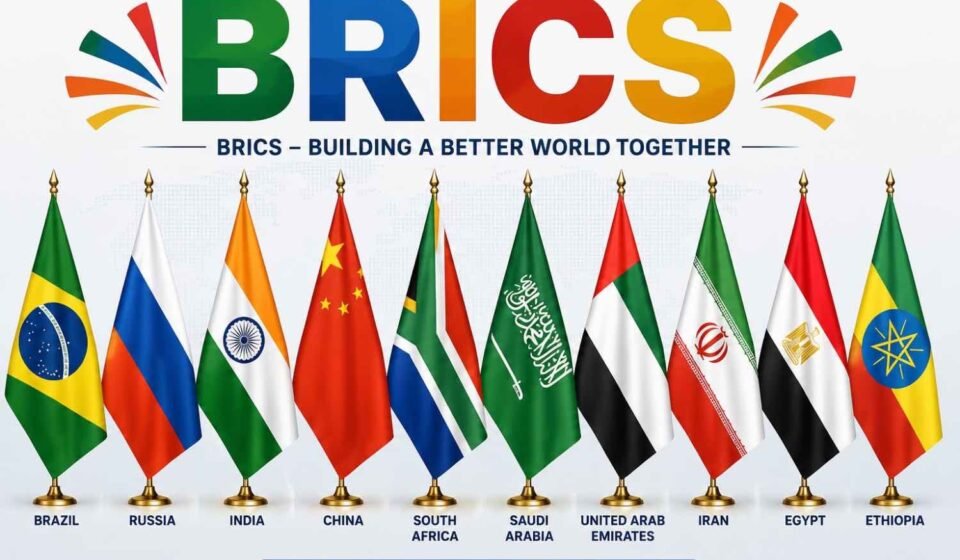

As the global geopolitical and economic landscape undergoes rapid transformation, plurilateral blocs are becoming increasingly vital. Among these, BRICS (originally comprising Brazil, Russia, India, China, and South Africa, and expanding to include several major emerging economies) stands out as a formidable platform.
For Indian citizens, policymakers, and business leaders, understanding BRICS goes beyond acronyms—it is about recognizing a coalition that shapes India’s economic future, energy security, and diplomatic stance on the world stage. Here are 5 key things every Indian should know about BRICS.
1. Massive Scale and Economic Weight
BRICS is no longer just an economic concept coined by Wall Street analysts; it has evolved into a concrete geopolitical bloc representing a massive share of the globe.
- Demographics & Economy: BRICS nations collectively account for over 40% of the world’s populationand roughly 37% of the global GDP.
- Global Influence: With continuous expansions—including recent additions like Egypt, Ethiopia, Iran, the UAE, and Indonesia—the bloc wields immense influence over international trade, energy corridors, and global supply chains.
2. An Alternative Financial Backbone (The NDB)
One of the most practical achievements of the bloc is the creation of the New Development Bank (NDB), headquartered in Shanghai, with a regional office (the India Regional Office) housed in Gujarat’s GIFT City.
- Funding Without Conditionalities: Unlike traditional Western-dominated institutions like the IMF or World Bank, which often impose strict structural adjustments, the NDB provides emerging economies with funding for sustainable infrastructure and development projects with greater flexibility.
- Empowering India: India has utilized NDB funding for critical domestic infrastructure, clean energy, and transport projects, aligning with national growth objectives.
3. Strategic Autonomy and Multipolarity
For India’s foreign policy, BRICS serves as a primary vehicle for promoting strategic autonomy and a multipolar world order.
- Balancing Global Governance: India has consistently advocated for reforming legacy global institutions (like the UN Security Council) to better reflect contemporary realities. BRICS provides a collective voice for the Global South to demand fairer representation.
- Navigating Geopolitics: BRICS allows India to maintain independent ties with Western democracies (via platforms like the Quad) while simultaneously engaging constructively with Eurasian and non-Western powers like Russia and China.
4. Push for Local Currency Trade and De-Dollarization
Discussions within BRICS have increasingly focused on reducing reliance on the U.S. dollar for international trade.
- Mitigating External Shocks: By promoting trade in local currencies (such as the Indian Rupee and other partner currencies), BRICS aims to shield developing economies from currency volatility, high transaction costs, and Western financial sanctions.
- Digital Financial Architecture: Initiatives exploring cross-border digital payment systems, central bank digital currencies (CBDCs), and blockchain-based settlement frameworks are gradually reshaping how regional commerce could operate in the future.
5. Managing Complexity: The China Factor and Internal Dynamics
While BRICS offers immense economic potential, it is essential to view the bloc with a pragmatic lens, keeping India’s unique strategic challenges in mind.
- The Bilateral Imbalance: China’s massive economic weight within the grouping creates structural trade imbalances for several members, including India. Managing economic competition with Beijing while cooperating on multilateral platforms remains a delicate tightrope walk for New Delhi.
- Diverse Interests: BRICS brings together nations with vastly different political systems and strategic outlooks. Recognizing that BRICS is built on consensus rather than a military alliance helps temper expectations—it is a platform for convergence on economic and developmental issues rather than a monolithic security pact.
The Takeaway: For India, BRICS is an indispensable diplomatic tool. It amplifies the voice of the Global South, drives alternative financial cooperation, and helps architect a balanced, polycentric world order essential for the 21st century.
How do you view India’s balancing role within BRICS amid shifting global alliances?